Modern HVAC technologies are advancing rapidly. Consequently, homeowners have numerous opportunities to enhance their system’s performance, efficiency, and convenience by following these six trends.
1. Smart HVAC, Sensors, and AI
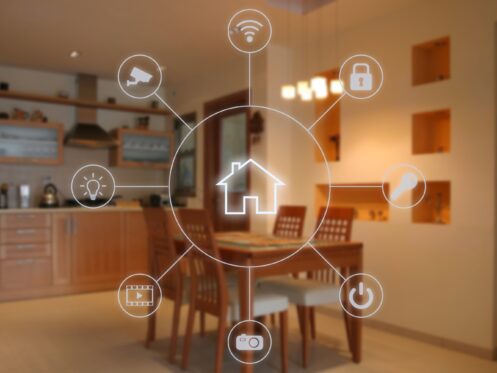
Programmable and smart thermostats are becoming common in many American households, but new technologies are taking them to the next level. Sensor packages for home HVACs are becoming more cost-accessible every year, giving you a chance to monitor your home in more detail than ever before. Sensors can monitor multiple rooms, collecting information about temperatures, humidity levels, and even occupancy numbers.
The real benefits kick in when homeowners add a robust sensor system to a smart HVAC system that uses AI. This AI-powered automation allows a smart thermostat to gather massive amounts of information about how a home’s HVAC is operating. Some advanced models even follow your preferences, learning your usage patterns and then adjusting without you ever intervening.
Many of today’s smart HVACs also include predictive maintenance. Using AI, the system can track run cycles and performance to determine how soon the HVAC will require maintenance. From replacing filters to scheduling tune-ups, predictive maintenance can save homeowners serious money by reducing the odds of a catastrophic failure. If the AI detects that the HVAC is beginning to operate out of spec, such as short cycling, it can even flag the issue and warn you that repairs may be needed. A well-maintained HVAC tends to last longer, have fewer expensive repairs, and operate more efficiently.
You can also connect many types of smart systems to your phone, entertainment center, security system, or voice assistant. This makes accessing and monitoring your HVAC very easy. Open the app, and you can adjust the HVAC while you’re away. For example, you might briefly override the programmable away settings while you’re on vacation. This lets a friend or family member checking on your house walk into a comfortable setting. You can then turn things down once they leave.
2. Zoned HVAC
With the ability to set up sensors and smart thermostats in multiple rooms, zoned HVAC is coming into its own. Although there have long been zoned systems that use dampers and fans to target more heating and cooling toward specific areas, smart technologies are making zoning easier and more precise. Modern technologies make it simple to command motors attached to vents, dampers, and fans. This allows the system to adjust on the fly, fine-tuning conditions in each zone to suit your needs.
In households where some individuals have very different climate control needs, you can configure a zone for each family member. Suppose someone needs a cooler and drier environment to sleep better. They can have their own HVAC zone without upsetting anyone else in the household.
Smart zoning also reacts in real-time to changing conditions. If the day gets a bit hotter than expected and the sun beats down on one side of your house, the zone system can adjust live and keep that part of your home comfortable.
3. Heat Pumps
The heat pump isn’t a new technology, but it is an HVAC system that’s rapidly getting better. Modern models often achieve efficiencies of 300%-400%, and some of the top options now push close to 500%. Geothermal and ground-source heat pumps also provide greater performance, even in extremely cold weather.
If you’re worried about how your heat pump might perform during a severe cold snap, you should consider a hybrid system. These are heat pumps that use a backup system, typically a gas or electric furnace, to handle heating in extreme conditions. You get all the efficiency benefits of a heat pump during normal days while also having the confidence that the system will handle rare moments of record cold weather.
Improvements in general HVAC refrigeration technology are also carrying over into the heat pump sector. This means many of the newest heat pumps operate at efficiency levels near or above 100% even in sub-zero weather.
4. Variable Systems
Variable Refrigerant Flow (VRF) systems are a rapidly growing segment of the HVAC market. In many traditional air conditioners and heat pumps, the refrigerant flows at one speed. VRFs significantly improve efficiency by adjusting the rate of flow as needed. Likewise, some systems support variable flows to different rooms, making HVAC zoning even more precise.
Variable-speed blower motors and fans are also improving HVAC performance. In a traditional HVAC, the airflow is either on or off. This means heating and cooling cycles tend to run for long periods before staying off for a bit. The net effect is peaks in heating and cooling, leading to noticeable swings in indoor comfort levels.
A variable system, however, can maintain a lower level of airflow for a longer period. This yields a more centered experience in terms of comfort. The temperature never swings too high or low.
Even better, variable-speed systems offer another way to get the most out of zoning your HVAC. By controlling the airflow to different rooms, you can keep conditions throughout your house very stable. Rooms that are far from the HVAC get a bit more heating or cooling to keep them comfortable.
5. Energy Recovery
Heat and energy recovery ventilators (HRVs and ERVs) recapture a significant portion of the energy that would otherwise be lost through the ventilation system. Pairing a heat exchanger with the ventilation and intake systems, recovery solutions use the ventilated heat to warm incoming air. The system then spends less energy heating fresh air. Not only does this improve efficiency, but it tends to benefit indoor air quality.
Some systems offer greater than 80% efficiency in recovering waste energy. For every five units that would otherwise go out of your home’s ventilation system, such a recovery system would retain four units. Many of these designs even work with ductless mini-splits.
6. Indoor Air Quality
With concerns about everything from viruses to pollution, indoor air quality has become a trending topic in HVAC. Fortunately, modern HVAC solutions are available for nearly every concern. HEPA filtration, once only common in hospitals and some businesses, is now readily available for residences. Activated carbon filters are also becoming more common to treat smells in indoor air. UV-C sterilization is a technology that breaks down the DNA and RNA of viruses, bacteria, and mold spores.
Many of these systems readily retrofit into existing HVAC units. By setting up the air quality systems in a separate chamber from the rest of the HVAC, you can perform all the filtration you need. Most designs filter the air return system, feeding clean air into your home’s heating and cooling systems.
Today’s sensor packages augment indoor air quality solutions, too. You can find sensors that monitor humidity, particulates, and chemical levels. Feeding this information to a smart HVAC with variable-speed systems allows it to draw more fresh air whenever air quality starts to slip.
A/C & Plumbing Doctors is a family business that puts more than 20 years of experience to work on HVAC projects. Our skilled technicians perform HVAC installations, repairs, upgrades, and maintenance. We welcome both residential and commercial HVAC jobs, too.
Contact A/C & Plumbing Doctors today to discuss which HVAC trends might benefit your Gilbert, AZ household.